In traditional finance, analysts often look at markets in patterns or “cycles” to understand how things change over time. In crypto, the closest parallel is Bitcoin’s four-year inflationary halving protocol, which has influenced past market behaviour. With most of Bitcoin’s supply already mined and recent market activity looking different from earlier years, some people are beginning to ask whether the next cycle will follow the same past pattern.
A halving is the scheduled moment when the Bitcoin network reduces the BTC reward miners receive for creating a new block. Historically, halvings have often been followed by price increases, although the relationship is based on observed market behaviour rather than guaranteed causation. In the past, these events were often followed by periods of stronger market activity, then a cooling phase, and eventually a period of rebuilding.
Traditional financial institutions have shown interest in offering their clients crypto exposure through Exchange Traded Funds (ETFs) rather than by offering direct access to crypto coins like BTC. Recent public filings indicate that several major banks and leading institutions hold positions in crypto-linked ETFs, which suggests they are showing a preference for the structure, custody, and oversight that fund-based products traditional financial institutions provide.
More companies and funds now hold Bitcoin as part of their treasuries or long-term reserves. This creates a different demand profile than in Bitcoin’s early years, when retail participants dominated the market. As more institutions hold Bitcoin for longer periods, its reactions to halving events can look different than before.
The growth of round-the-clock derivatives markets has also changed how traders manage risk, since participants can adjust their exposure at any time. Tools like perpetual futures, options, and structured hedging products allow participants to react immediately to news or volatility. This constant ability to offset or amplify exposure can smooth out some of the movements that defined earlier cycles, or in some moments, accelerate them.
Miner economics are still adjusting. As block rewards fall, miners earn less newly issued Bitcoin. For a period of time last year, activity around BRC-20 tokens and inscriptions helped offset some of that decline through higher transaction fees. More recently, those fees have been less consistent, which means miners continue to balance energy costs, hardware efficiency, and overall profitability.
BRC-20s are built on Bitcoin’s Ordinals system, which allows small pieces of data to be written directly onto individual satoshis. It turns Bitcoin’s ledger into a kind of permanent, unchangeable library where token metadata can be stored. Unlike Ethereum’s ERC-20 tokens, which are fully programmable, BRC-20s rely on this data-storage mechanism rather than smart contracts, making them simpler but also limited in functionality. BRC-20 is an experimental token standard and does not have native enforcement at the protocol level; all logic depends on off-chain indexers.
BRC-20 vs. ERC-20
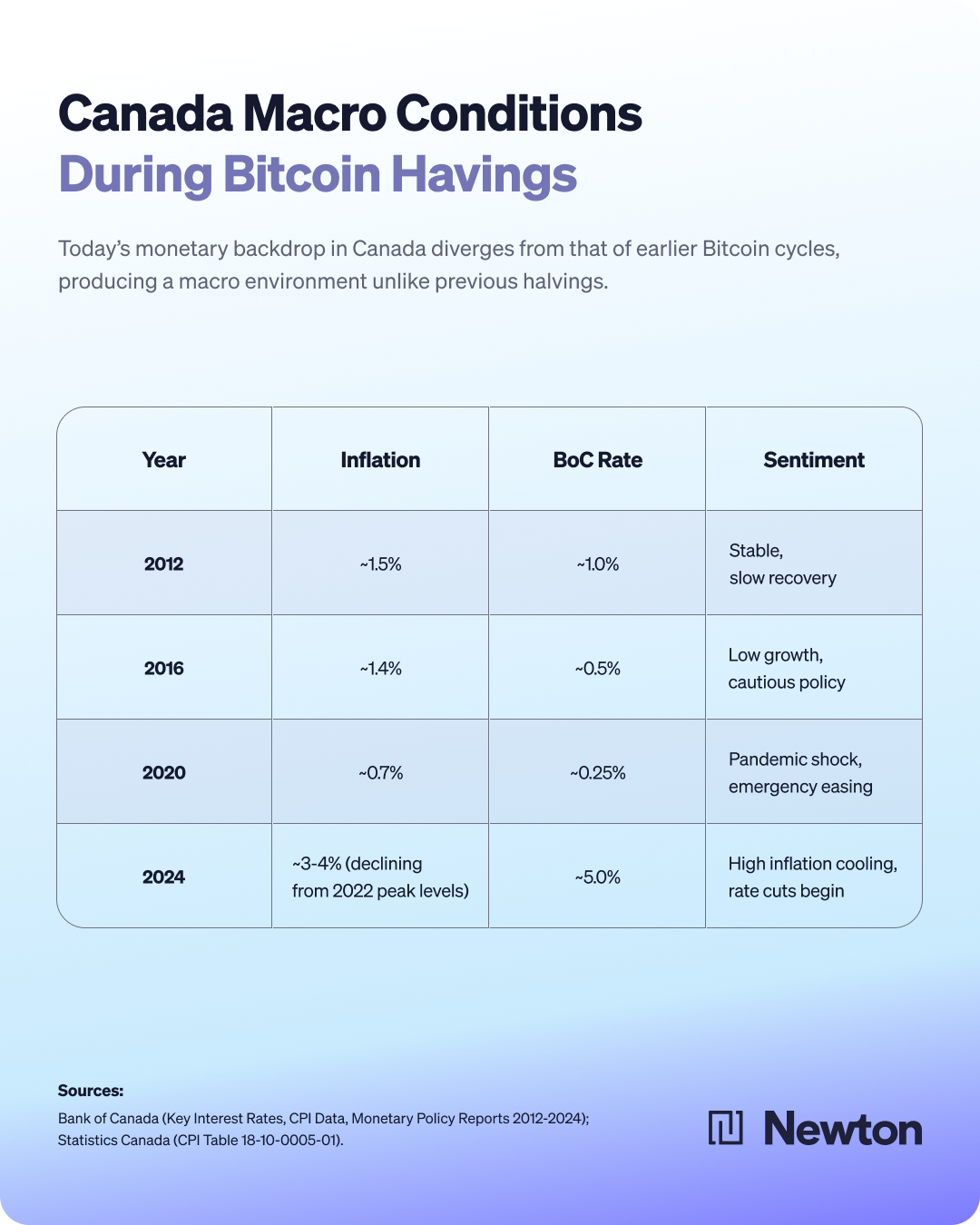
Monetary conditions in Canada and the United States look different today than they did during Bitcoin’s earlier cycles. Rate policy in Canada and the United States have also changed. Both central banks cut rates by 25 basis points last month, with each signalling different concerns, from weak productivity to ongoing inflation. These factors create a macro setting unlike the one that surrounded earlier halvings.
Canada Macro Conditions During Bitcoin Halvings
The blockchain industry is still taking shape, and many questions remain. People continue to wonder if growing institutional activity could change how long a cycle lasts and behaves. These ideas serve as a reminder that the market is developing and much of its direction is still taking shape.
Market cycles can be helpful for analysts and investors to look at, but they can’t tell the future. What they do show is how things moved before, not how they will move again. That doesn't mean patterns should be ignored altogether. They can offer perspective, they’re just not promises. The familiar reminder still applies: what happened in the past doesn’t guarantee what comes next. Keeping a flexible, open perspective is the most grounded way to approach cycles in an emergent market that continues to find its way and mature.
If you found this article helpful, take a look at the other crypto explainers on our blog.


.png)