Sign-up to get started
Get onboarded and start trading with as little as $50.


jup
jup
Jupiter is a decentralized exchange aggregator on the Solana blockchain, designed to aggregate liquidity from multiple sources for efficient cryptocurrency trading. It provides users with advanced trading tools like swap, limit orders, and dollar-cost averaging (DCA) to optimize their trading experience with minimal slippage.
This coin is not available on Newton.
As the DEX aggregator with the highest volume in Jupiter markets, it enhances crypto prices by offering access to the best available live price across multiple platforms. The platform also tracks global Jupiter prices, displaying trends through the Jupiter price chart and JUP historical price data. Its growing total value locked (TVL) reflects its increasing role in decentralized finance (DeFi).
Jupiter is expanding its ecosystem with JUP tokens, which increase the circulating supply and contribute to the platform’s marketcap. The upcoming JUP airdrop will distribute a significant amount of coins, further integrating users into the ecosystem. Metrics like theoretical market capitalization and maximum market cap help assess Jupiter’s valuation within the crypto space.
Beyond trading, Jupiter plans to launch a decentralized exchange for perpetual futures, allowing users to engage in leveraged trading. It also aims to introduce a decentralized stablecoin, addressing concerns about centralized alternatives while maintaining a strong TVL.
With its user-friendly interface, security features, and continuous innovation, Jupiter is shaping the future of cryptocurrency trading. It remains a key player in the crypto journey, providing users with essential tools and insights in a rapidly evolving market.
Jupiter operates as a decentralized exchange (DEX) aggregator, combining liquidity from various platforms to optimize cryptocurrency trading. It integrates automated market makers (AMMs) and order book-based DEXs, enabling efficient trade execution. By leveraging blockchain technology, Jupiter enhances transaction speed while keeping fees low, making it a relevant tool for traders seeking improved price execution.
Users can interact with Jupiter through its interface or integrate its features into decentralized applications using APIs. These APIs provide access to pricing data, swaps, and advanced trading options like limit orders. Market sentiment plays a key role in Jupiter’s performance, affecting the JUP price chart over the past 7 days and influencing its total market value on a rolling 24-hour basis.
Jupiter also functions as a bridge aggregator, allowing users to transfer digital assets between different blockchain networks. It offers a dollar-cost averaging (DCA) feature, which lets users buy cryptocurrencies at scheduled intervals. Unlike shares in the stock market, a cryptocurrency’s circulating supply depends on factors such as the number of coins already created, minus any that have been removed from circulation or locked by insiders.
Liquidity providers can deposit an amount in assets into Jupiter’s liquidity pool, earning a portion of the fees generated from perpetual trading. Traders borrowing from the pool can use leverage up to 100x, increasing market activity and returns for liquidity providers. If the FDV is greater than the cryptocurrency’s circulating supply, it may indicate a ratio of more than 1.0, which can be an important consideration for investors analyzing Jupiter’s valuation.
Jupiter has introduced the LST stablecoin, backed by Solana Liquid Staking Tokens (LSTs), which represent staked Solana. These tokens are locked to mint sUSD, Jupiter’s stablecoin, which is overcollateralized to maintain its value. Holders of sUSD receive staking rewards, turning it into a yield-generating digital asset. This system strengthens liquidity within Jupiter’s ecosystem while providing users with potential reward opportunities.
The Jupiter token (JUP) is a cryptocurrency designed to enhance blockchain security and usability. Here’s how it works:
You can track Jupiter markets through various platforms that analyze price movements and trading activity. Here’s where to look:
A Jupiter price chart helps traders analyze market movements and historical trends. Here’s how it benefits users:
JUP’s historical price shows its market performance and growth over time. Here are key aspects:
The JUP token plays a key role in the governance of the Jupiter platform, allowing community members to participate in shaping its future. Holders can vote on proposals and policy changes, influencing platform development. This decentralized model prevents central control while maintaining transparency. By distributing decision-making, Jupiter is valued as a community-driven ecosystem.
Another function of JUP is its role in community voting for ecosystem projects. Token holders can contribute to decisions that impact platform growth, making participation more inclusive. A structured system is used to approximate a protocol’s voting process, aiming for accuracy in results. This strengthens engagement and aligns development with user interests.
The token also supports a staking mechanism, enabling users to earn rewards by locking their assets. A portion of JUP remains readily available in the market while some is allocated to stakers. To prevent manipulation, a linear distribution model is under consideration. This approach helps balance participation and sustainability.
Liquidity aggregation is another essential function, as Jupiter facilitates token swaps and perpetual futures. The technology behind this process enhances trading efficiency, similar to how other DeFi aggregators operate. With increased market participation, JUP converter tools help users navigate price changes. Volatility is a factor, but aggregated liquidity improves transaction stability.
Also, JUP encourages ecosystem participation through incentives such as airdrops. Users who engage actively may benefit from rewards based on their interactions. While this can enhance user involvement, it should not be considered investment advice. For accurate insights, checking Jupiter latest news or Jupiter guides can provide relevant updates.
Jupiter (JUP) was launched in October 2021 by the pseudonymous developer ‘Meow’ with the goal of creating Solana’s premier decentralized exchange (DEX) aggregator. Initially focused on providing efficient and low-cost token swaps, it quickly gained traction within the Solana ecosystem. Its advanced routing system allowed users to access the best trading rates across multiple liquidity sources.
As the project grew, Jupiter expanded beyond simple swaps and positioned itself as a full-stack DeFi ecosystem. In September 2024, it acquired SolanaFM, a blockchain explorer, to enhance its data infrastructure and analytics capabilities. It also announced the acquisition of Coinhall, a multi-chain trading terminal, reinforcing its presence in the broader DeFi market.
In early 2025, Jupiter made headlines with one of the largest token airdrops on Solana, distributing 700 million JUP tokens. This event, called "Jupuary," rewarded early users, stakers, and contributors while solidifying the JUP token as the governance asset of the Jupiter DAO. Community members, known as “Space Catdets,” continue to play a central role in shaping the platform’s future.
To improve accessibility, Jupiter launched a mobile app in partnership with MoonPay, enabling users to swap tokens seamlessly using Apple Pay and Google Pay. Additionally, it introduced Metropolis, an API platform designed to streamline liquidity solutions for developers. These advancements aim to make decentralized trading more user-friendly and scalable.
In December 2024, Jupiter expanded beyond Solana by partnering with the TON Foundation to build a liquidity aggregator for the TON blockchain. This collaboration strengthens cross-chain interoperability and enhances liquidity aggregation across multiple ecosystems. With continuous innovation and strategic partnerships, Jupiter remains an influential player in the decentralized finance space.
Jupiter’s latest news can be found on various platforms that track market developments and project updates. Here’s where to look:
A JUP converter enables users to calculate the value of Jupiter in different cryptocurrencies. Here’s how it helps:
Jupiter guides provide essential insights for traders and investors in the crypto space. Here’s why they are useful:
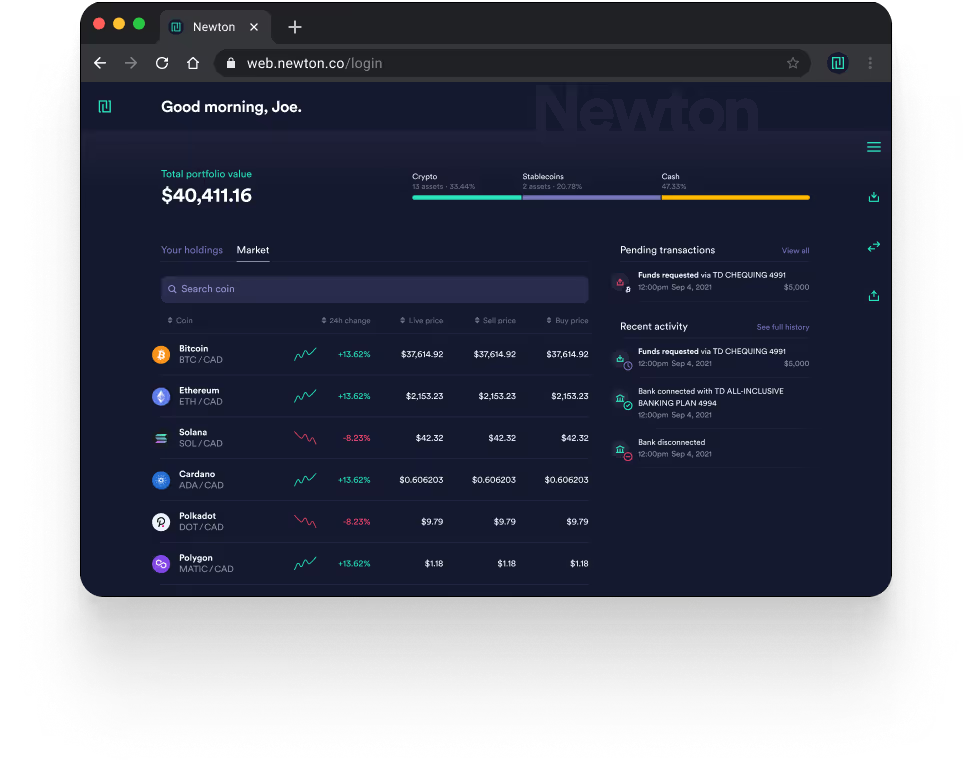
Your security is important. Newton is committed to being a leader in compliance, security, and technical protocols.
For additional information and to review the risks associated with Jupiter, please see our Asset Statement.


