Newton
Your way into crypto.
Bear markets do not just drain prices; they also drain investor confidence, making inaction at times feel safer than action. This is not a personal failing, but rather a natural response to uncertainty.
It helps explain why “buy low, sell high” sounds simple in theory, yet proves difficult in practice, and why results often diverge even within the same market. After all, if it were easy, everyone would be able to master the markets.
In 2025, several top-10 cryptocurrencies, including Bitcoin, Ethereum, and Solana, finished the year at lower price levels than where they began. In environments like this, timing is hard to get right, and even harder to repeat. This is why dollar-cost averaging is often discussed. Not as a promise of better returns, but as a way to reduce the emotional burden of decision-making.
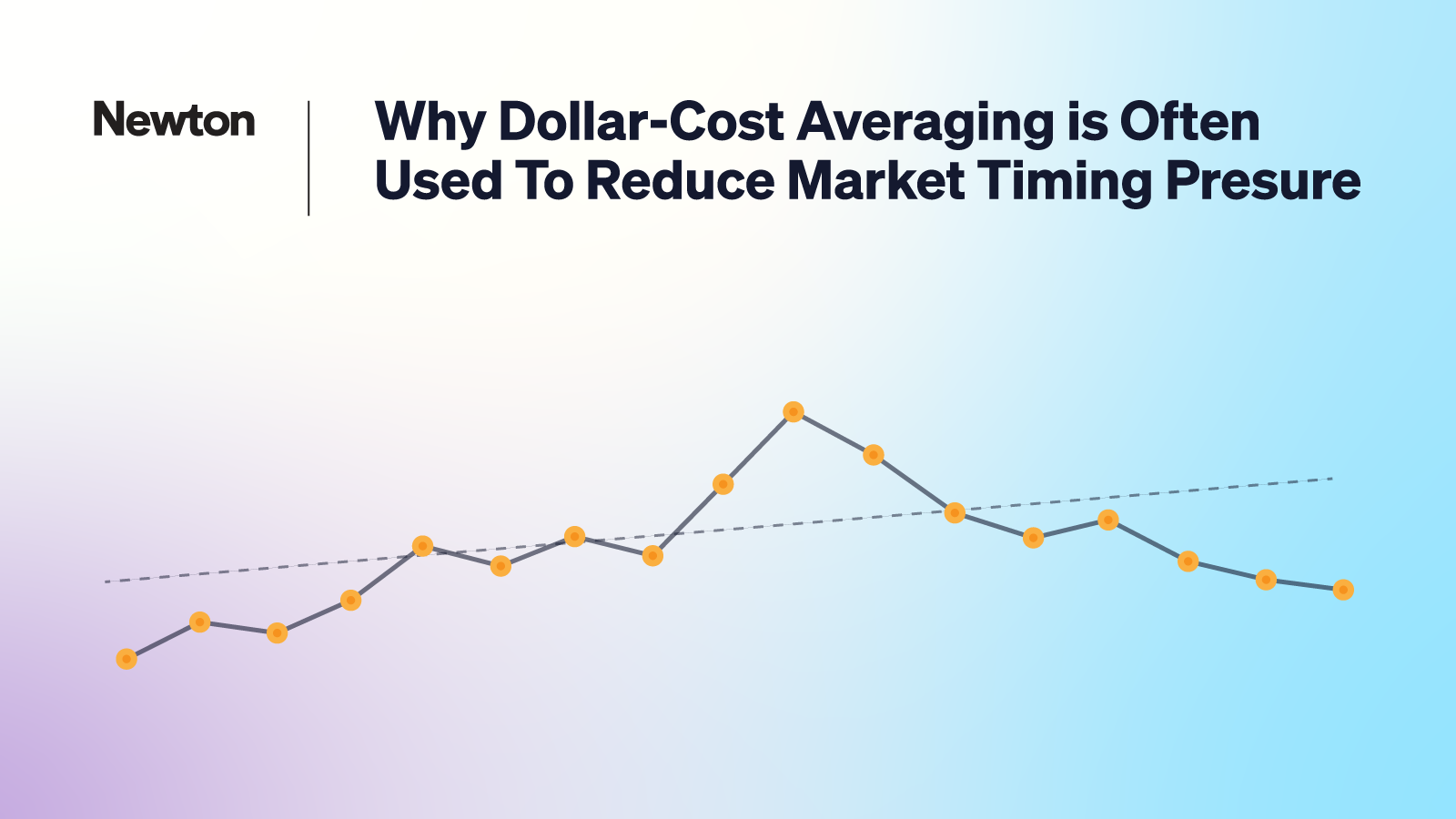
Dollar-cost averaging is an approach that involves investing fixed amounts at regular intervals, regardless of short-term price movements.
The idea starts with acknowledging how difficult market predictions really are. It was formalized long before digital assets existed, in early value investing frameworks that emphasized discipline over precision.
By investing smaller amounts at regular intervals, dollar-cost averaging spreads decisions over time. It removes the pressure of choosing the “right” moment and replaces it with a repeatable process that does not require constant judgment calls.
For many people, the hardest part of investing is not understanding the strategy. It is staying consistent when confidence is low. Quiet months or sideways markets are often when conviction feels thin, and having a defined process can help reduce the friction of repeated decision-making.
The challenge with timing the market is not understanding the concept, but living with the uncertainty between decision and outcome.
A small number of assets drove a disproportionate share of gains in 2025, while large parts of both equity and crypto markets have remained negative. In environments like this, investing becomes less about direction and more about exact timing, but market timing is difficult to sustain.
A five-year stretch helps illustrate the point. Over that period, our investor Jane contributed $20 every two weeks to Bitcoin and Ethereum while experiencing multiple market cycles, including sharp drawdowns and periods of recovery.
She made no adjustments and did not attempt to wait for better entry points. She steadily contributed through bull markets, bear markets, and her total contribution added up to approximately $2,600 CAD per asset.
Using rounded historical price averages in CAD dollars for illustration purposes only, that consistent contribution pattern would have led to an estimated portfolio value of approximately:
Bitcoin: ~$6,200–$6,500 CAD by the end of 2025
and
Ethereum: ~$8,700–$9,200 CAD by the end of 2025
Different start dates, contribution periods, or asset selections could have produced materially different outcomes, including lower or negative results. This illustration is intended to show how contributions may be distributed across market conditions, not to demonstrate performance.
What stands out is not the endpoint, but Jane’s path.
Many of her contributions occurred during periods when prices were falling, and some happened when the coins were hitting their all-time highs. Moments when opening her app may have felt uncomfortable to even consider, and ignoring red charts may have felt easier than confronting them.
Dollar-cost averaging cannot make markets predictable or reduce market volatility. For some investors, the approach can take some of the weight off individual decisions.
This mock example is provided for educational purposes only. It assumes biweekly contributions of $20 CAD from January 2020 through December 2025 and uses rounded historical price averages to illustrate how dollar-cost averaging works over time. Figures are estimates, do not reflect exact market pricing, and are not indicative of future results or the effectiveness of any strategy.
For others, the challenge with dollar-cost averaging is not understanding the approach, but maintaining it over time. Regular contributions can be easy to plan, but harder to execute consistently when markets are volatile or attention is elsewhere.
That is why tools such as automatic recurring buys are made to help this kind of consistency by minimizing the requirement to repeatedly revisit the same action. Instead of deciding when to act each time, the structure is defined, set up in advance, and carried out automatically.
A recurring buy allows you to schedule regular market order purchases of a chosen asset at a set amount and frequency.
In the Newton app, this option is available through the Trade section. Once set up, you decide which asset to buy, how much to contribute, and the cadence that works for you. The start date simply marks when the process begins.
Before confirming, the app will show you a projected view of how your scheduled purchases may accumulate over time. This is intended to help you understand the level of commitment you are setting, rather than to predict your future financial outcome.
Once a recurring buy is set up, purchases are placed automatically according to the schedule you chose.
Yes, recurring buys can be adjusted or paused as circumstances change.
What practical considerations apply to recurring buys?
There are a few operational details to be aware of when using recurring buys:
Most investing decisions are not made in calm moments. They are made in between workdays, headlines, and doubt. Having a defined process can reduce the sense that every decision has to be perfectly timed.
For step-by-step guidance on setting up recurring buys, a walkthrough is available in the app. If you have questions about how the feature works, Newton’s support team can help at newton.co/support.
In value-oriented approaches, the emphasis is often not on reacting well in any single moment, but on having a process that can be carried forward throughout. What matters most is that your risk tolerance and time horizon are aligned with the decisions you are making.
Viewed as a whole, the role of dollar-cost averaging is less about prediction and more about process.
If you are new to crypto or if you have been in the space for years, Newton’s blog offers resources for everyone. Our learning content is designed to be beginner-friendly without skipping the deeper ideas, because we believe the future of money should be understood.


.png)