Canada’s Digital Economy in June 2026: Rates held, enforcement sharpened

July 8, 2026
Newton Team
July 8, 2026
Canada’s Digital Economy in June 2026: Rates held, enforcement sharpened

June 2026: Steady rates, sharper rules
‍

June was less about new direction and more about follow-through. Central banks stayed cautious, gasoline pushed inflation higher, and Canadian regulators moved further into the details: consultation, supervision, platform accountability, and digital policy reform.

Across Canada and the U.S., the theme was the same: the rulebook is moving from broad policy signals into practical application.

Market Moves

The Bank of Canada held at 2.25% on June 10. The overnight rate stayed at 2.25%, reinforcing the Bank's cautious stance as Canada navigates softer economic growth and energy-driven inflation pressures. The Bank also reiterated that the next scheduled decision is July 15, keeping attention on each new round of economic data.

The U.S. Federal Reserve held rates steady on June 17. The FOMC maintained the target range for the federal funds rate at 3.5% to 3.75%, keeping the U.S. policy story in "higher for longer" territory as inflation remains elevated relative to the Fed's 2% goal.

Inflation re-accelerated, led by gas. Canada's CPI rose 3.2% year over year in May, with gasoline up 33.2% as Middle East supply uncertainty pushed pump prices higher, a reminder of how fast geopolitical risk reaches household costs.

Canada dodged a technical recession. GDP expanded 0.5% in April, the fastest monthly growth since July 2025, easing recession fears after a stagnant winter. Growth was broad-based but anchored by a 2.9% jump in mining and energy as the oil sands ramped back up.

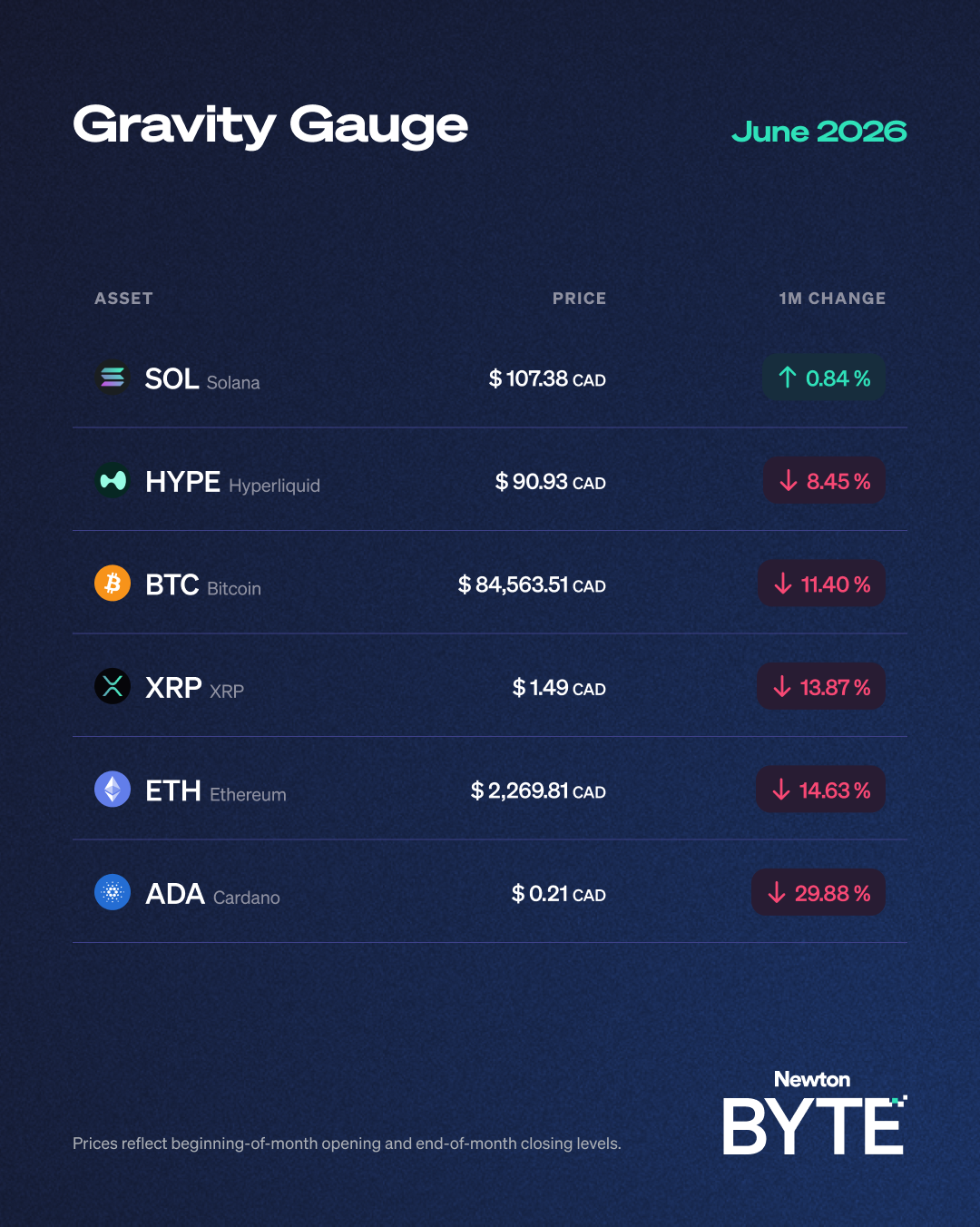
Crypto markets ended June under pressure, though early July brought some relief. Bitcoin closed out June around C$83,000 after falling from its mid-May high near C$110,000, putting it more than 50% below its October 2025 all-time high of roughly C$173,000. As of July 2, it had moved back toward C$87,000, offering a modest rebound after a difficult month. Ethereum also remained under pressure, and crypto sentiment moved into "extreme fear" territory as risk appetite weakened across the market.
Signal

  • [Canada | Regulation]  Stablecoin oversight moved further from policy to process. Ottawa’s stablecoin framework is now more explicit about next steps: supporting regulations are being developed and will be published for consultation through the Canada Gazette, with the Bank of Canada positioned as the primary supervisor for non-financial stablecoin issuers.
  • [U.S. | Enforcement] The CFTC ordered penalties for illegal off-exchange crypto transactions involving U.S. customers. On June 29, the CFTC ordered two foreign firms to pay $2.5 million for illegal off-exchange transactions with U.S. customers. The action was another reminder that digital asset enforcement is increasingly focused on how platforms serve users across borders.
  • [Canada | Digital rules] Ottawa made June an AI and data month. Canada launched “AI for All”, introduced Bill C-34, covering online safety for social platforms and AI chatbots, and tabled Bill C-36, focused on privacy reform. The privacy bill would recognize privacy as a fundamental right and give the new privacy regulator stronger order-making, audit, and penalty powers. Together, the announcements show how digital policy is broadening beyond crypto into the wider infrastructure of online trust, data protection, and AI accountability.
  • [Canada | Enforcement] The OSC kept the focus on platform accountability. In June, the OSC issued a series of investor warnings against non-compliant crypto asset trading platforms and unauthorized entities operating in the province. These updates continue to expand the regulator's public alert list, reinforcing strict registration expectations for any firm attempting to access Ontario markets.

This is one part of an ongoing conversation. In next month's BYTE, we'll keep tracking how crypto, markets, and policy are taking shape.

‍

No items found.

*Although the term "stablecoin" is commonly used, there is no guarantee that the asset will maintain a stable value in relation to the value of the reference asset when traded on secondary markets or that the reserve of assets, if there is one, will be adequate to satisfy all redemptions.* *This article is for informational purposes only and does not constitute tax, investment, financial, or legal advice. Cryptocurrencies and blockchain-based assets are highly speculative, subject to significant risks including price volatility, regulatory uncertainty, and potential total loss of investment. Crypto assets are not insured by the Canada Deposit Insurance Corporation (CDIC). Cryptocurrencies and stablecoins may be considered securities or derivatives under Canadian law, subject to the Canadian Securities Administrators and Canadian Investment Regulatory Organization oversight. Consult a qualified financial or legal professional before making investment decisions. No securities regulatory authority has expressed an opinion about any of the crypto assets made available on Newton’s platform, including any opinion that a crypto asset is not a security and/or derivative.*
Newton Team
Follow Newton on LinkedIn
Follow Newton on YouTube
Follow Newton on LinkedIn
Follow Newton on Twitter
BACK TO BLOG