May was quieter on the surface than the months before it. No Bank of Canada rate decision, no emergency domestic economic update, and no single market-moving shock. What it had instead was a steady accumulation of infrastructure news — the kind that doesn't move markets in a day but tends to matter more over time.
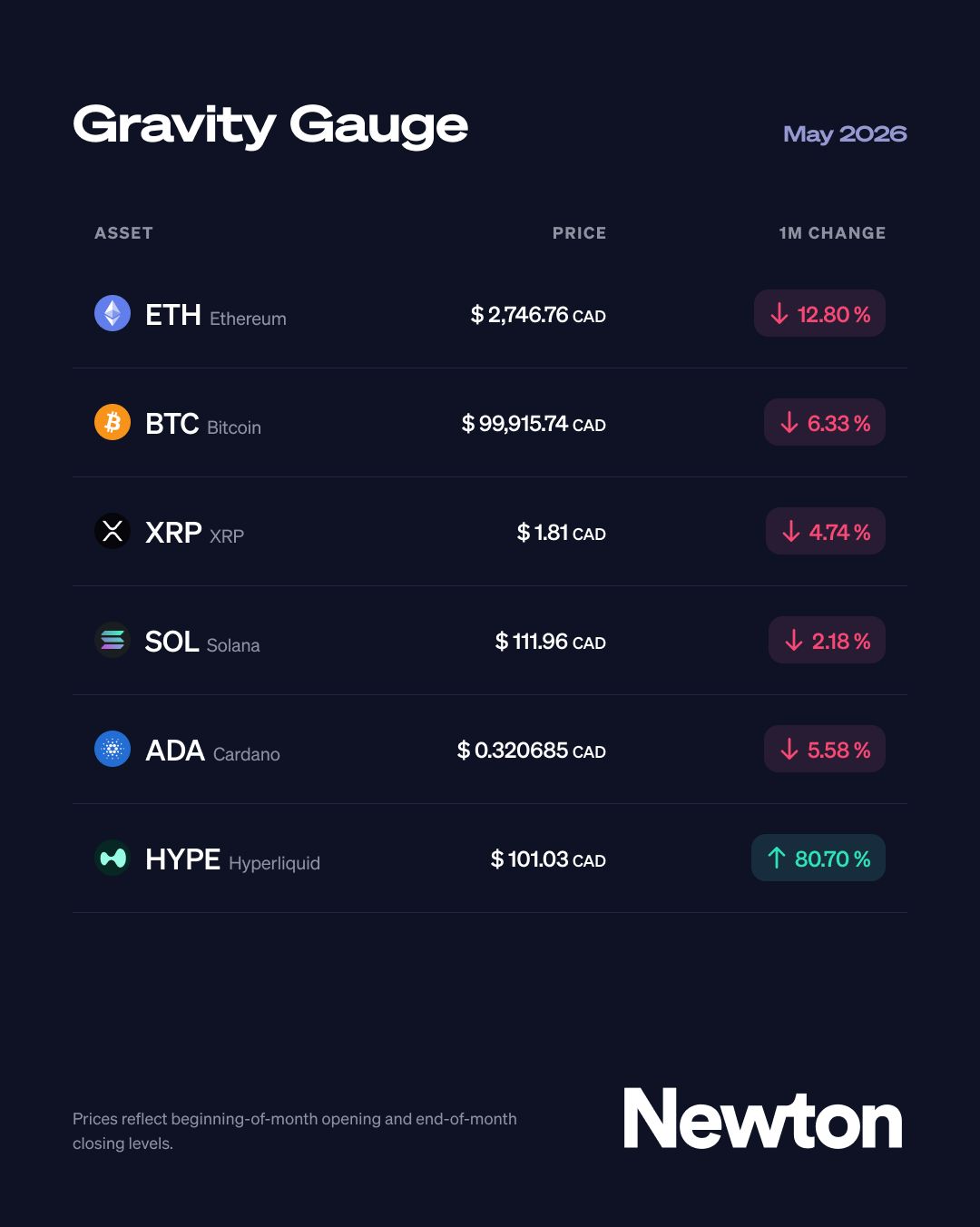
Crypto markets found some footing, briefly. After a difficult start to 2026, the total crypto market cap recovered from its February lows and was up roughly 30% by mid-May. But the rebound did not hold evenly across the market. Bitcoin was more resilient than many smaller cryptoassets, while Ethereum and parts of the altcoin market continued to lag. By month-end, the rebound had already faded, leaving the market lower than its mid-May highs and still under pressure heading into June.
Signal
[Canada | Payments] The Bank of Canada dives into Project Agorá. On May 27, the BoC officially stepped into the BIS’s Project Agorá, an initiative exploring how tokenization could improve wholesale cross-border payments. The project is testing whether tokenized central bank reserves and commercial bank deposits can reduce long-standing frictions in multi-currency settlement. Its prototype has shown the possibility of atomic settlement across currencies, where transaction chains complete on an “all-or-nothing” basis. As Agorá advances toward real-value testing, the Bank of Canada is taking a more active role in research on how money moves across borders.
[Canada | Regulation] Ottawa is building a conservative framework for fiat-backed stablecoins. Canada’s upcoming stablecoin regime is finally coming into focus. The framework will apply to fiat-backed stablecoins issued by non-financial institutions and put those issuers under Bank of Canada supervision. Do not expect this overnight. The BoC has called an early-2027 target “ambitious,” with regulations potentially arriving closer to mid- or late-2027. The playbook is conservative: high-quality liquid reserves, reliable redemption at par value, and trust before speed. The timeline is slow, but the rules of the road are starting to take shape.
[Global | Policy] The US CLARITY Act edges forward. It is still a slow grind, but the US Senate Banking Committee advanced the Digital Asset Market Clarity Act in May, moving crypto market structure legislation another step through Congress. The bill matters because it would create a broader regulatory framework for digital assets and draw clearer lines between digital commodities and securities. Its asset-classification approach also overlaps with March 2026 SEC interpretive guidance joined by the CFTC, which distinguished between digital commodities and digital securities. Worth watching for Canadian firms: whatever Washington builds here could influence cross-border digital asset regulatory expectations for years.
Whether you are new to crypto or have been in the space for years, Newton’s blog offers resources for everyone. Our learning content is designed to be beginner-friendly without skipping the deeper ideas, because we believe the future of money should be understood. This is one part of an ongoing conversation. In next month’s BYTE, we will continue tracking how crypto, markets, and policy are taking shape.
No items found.
This article is for informational purposes only and does not constitute tax, investment, financial, or legal advice. Cryptocurrencies and blockchain-based assets are highly speculative, subject to significant risks including price volatility, regulatory uncertainty, and potential total loss of investment. Crypto assets are not insured by the Canada Deposit Insurance Corporation (CDIC). Cryptocurrencies and stablecoins may be considered securities or derivatives under Canadian law, subject to CSA and CIRO oversight. Consult a qualified financial or legal professional before making investment decisions. No securities regulatory authority has expressed an opinion about any of the crypto assets made available on Newton’s platform, including any opinion that a crypto asset is not a security and/or derivative.
.png)




.png)