March didn't bring a new storyline. It made the current one harder to ignore. Inflation, interest rates, and global tensions continued to shape how markets moved, and digital assets were no exception.
Market Moves
Rate decisions came into focus in March. The Bank of Canada left its policy rate at 2.25 percent, a decision that reflected a real tug-of-war beneath the surface: softer domestic data on one hand, and inflation risks (reignited in part by energy) on the other. The Federal Reserve followed a similar path, holding rates in the 3.50–3.75 percent range. Neither central bank leaned toward cuts, and both signalled a wait-and-see approach heading into the second quarter. For now, the message was restraint.
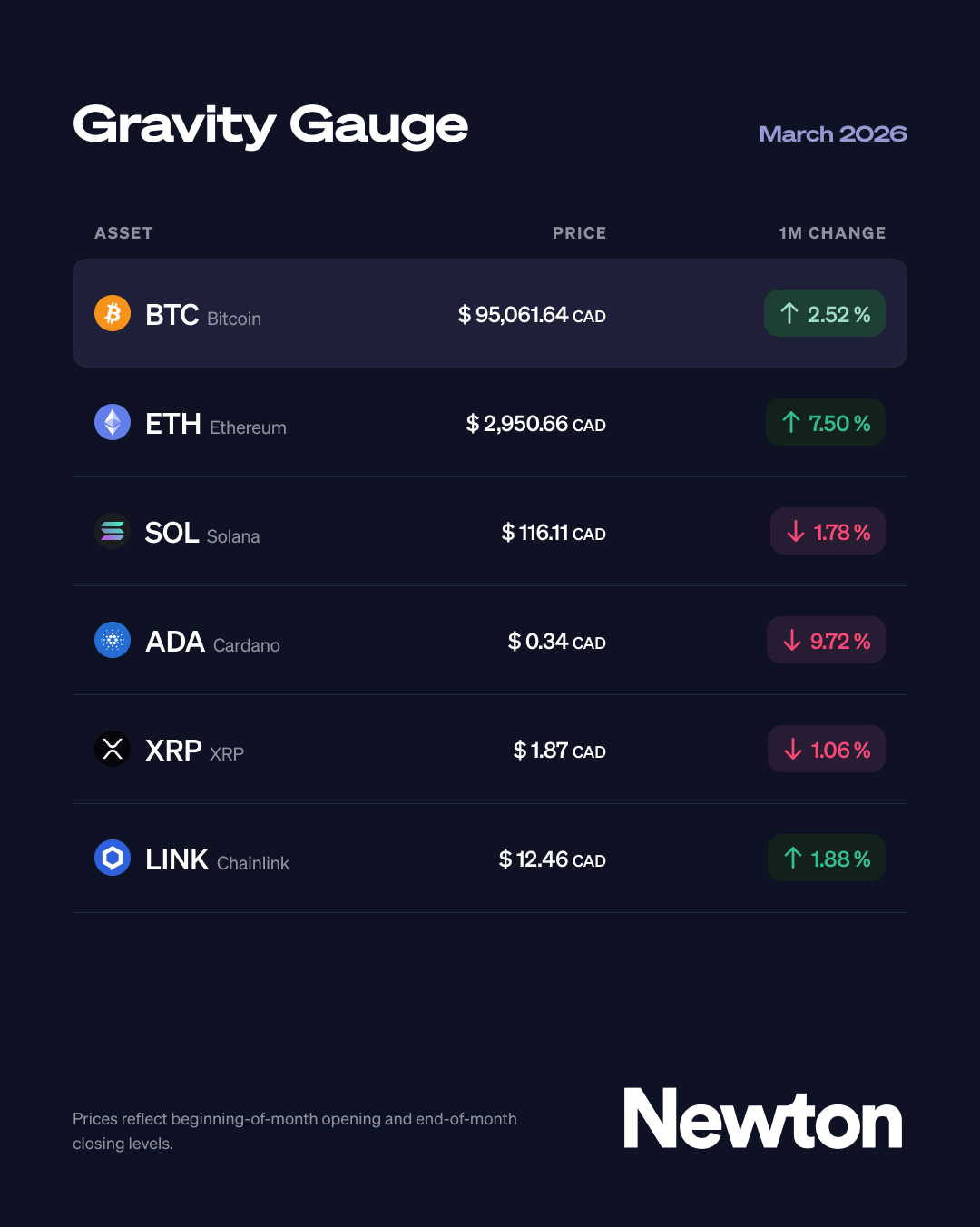
Oil told a louder story. Brent crude moved decisively above USD100 a barrel, and remained volatile as tensions around the Strait of Hormuz and the broader region escalated. Since the period covered, a ceasefire announcement has sent oil prices sharply lower; a reminder of how quickly the macro picture can shift. Bitcoin moved through its own swings. The price of BTC slipped from roughly USD70,000 to USD63,000 during periods of escalation, then found its footing again, consolidating back in the low USD70,000s.
Then there was a quieter milestone. On March 10, the 20 millionth Bitcoin was mined. Fewer than one million remain to be mined, and with each halving, the rate of new issuance drops by half, stretching the remaining supply out over more than a century. It's a useful reminder of something easy to overlook in more volatile moments: Bitcoin's scarcity isn't adjusted or negotiated. It's fixed in code.
[Canada] On March 26, stablecoin provisions within Canada's 2025 budget legislation received Royal Assent, establishing the country's first dedicated federal framework for fiat-backed stablecoins. The Bank of Canada will play a central supervisory role, particularly for non-bank issuers, signalling how these assets are being positioned within the broader payments system. Further rules and phased implementation are expected over the coming years, but the move brings regulatory clarity for Canadian firms operating in the space.
[Global]On March 17, the SEC and CFTC issued an interpretive framework that classified 16 major crypto assets as digital commodities, including Bitcoin, Ethereum, Solana, and Cardano. The framework goes beyond a simple list, outlining how regulators are approaching decentralisation and control. Given how closely linked Canadian and U.S. markets are, developments like this tend to carry cross-border implications.
[Politics]The political tone is shifting as well. At the Future Investment Initiative Summit in Miami on March 27, President Trump described Bitcoin as "very powerful" and framed the industry in geopolitical terms, warning that China could take the lead if the U.S. falls behind. It's not policy, but it signals a direction that other countries, including Canada, are likely watching closely.
[Action Item] Canada is moving toward adopting the OECD’s Crypto-Asset Reporting Framework (CARF), which will introduce new reporting requirements for crypto platforms and investors in the coming years. With tax season underway, Canadian crypto users are encouraged to review their reporting obligations with a qualified accountant or through the CRA’s online resources. Newton users can export their account's transaction history directly from the Newton app, and the Koinly integration has returned for the 2025 tax year to simplify reporting. A 20% discount on paid Koinly plans is available with code NEWTON26 through April 30, 2026.
[Canada] Bill C-25, introduced on March 26, proposes a ban on cryptocurrency donations across the federal political system. The bill groups digital assets with money orders and prepaid cards as harder-to-trace payment methods, citing election integrity and foreign interference concerns. No major federal party has reported accepting crypto donations in either the 2021 or 2025 elections. The bill is currently before the House of Commons.
Whether you are new to crypto or have been in the space for years, Newton’s blog offers resources for everyone. Our learning content is designed to be beginner-friendly without skipping the deeper ideas, because we believe the future of finance should be understood. In next month’s BYTE, we will continue tracking how crypto, markets, and policy are taking shape.
No items found.
This article is for informational purposes only and does not constitute tax, investment, financial, or legal advice. Cryptocurrencies and blockchain-based assets are highly speculative, subject to significant risks including price volatility, regulatory uncertainty, and potential total loss of investment. Crypto assets are not insured by the Canada Deposit Insurance Corporation (CDIC). Cryptocurrencies and stablecoins may be considered securities or derivatives under Canadian law, subject to CSA and CIRO oversight. Consult a qualified financial or legal professional before making investment decisions. No securities regulatory authority has expressed an opinion about any of the crypto assets made available on Newton’s platform, including any opinion that a crypto asset is not a security and/or derivative. Newton hereby expressly disclaims any and all express or implied warranties of any kind with respect to Koinly, its software, and its service offerings. Koinly and Newton have entered into a revenue-sharing partnership to provide a discount on paid plans. Newton is not responsible for, nor does Newton control, the content, products, or services provided by any linked third-party websites or services, including those of Koinly. We do not endorse or guarantee the products, information, services, or recommendations provided by linked websites and are not liable for any failure of products or services advertised on Koinly or on any other websites. In addition, each third-party website may provide less security than we do and may have a substantively different privacy policy. You should review the security and privacy policies of such third-party websites. Your access, use, and reliance upon such content, products, or services are at your own risk.




.png)