Newton
Your way into crypto

“If there is one thing to learn, and we have all just learned it painfully, this is not a straight line.”
— Mike Novogratz
Volatility has been a defining feature of the cryptocurrency market since its onset, but the past week, Bitcoin’s move below the $100,000 CAD level has made things feel a bit different. Maybe the 4-year cycle isn’t over after all?
We wanted to look at what may have been driving the reaction by drawing on how long-time participants are interpreting the moment. Recent moves have been hard to pin on any one headline, with several factors appearing to be interacting at the same time, including positioning, leverage, and shifting expectations. Below, we highlight a few of those perspectives to help frame what has been happening. This is meant to add context, not to suggest how markets may behave going forward.
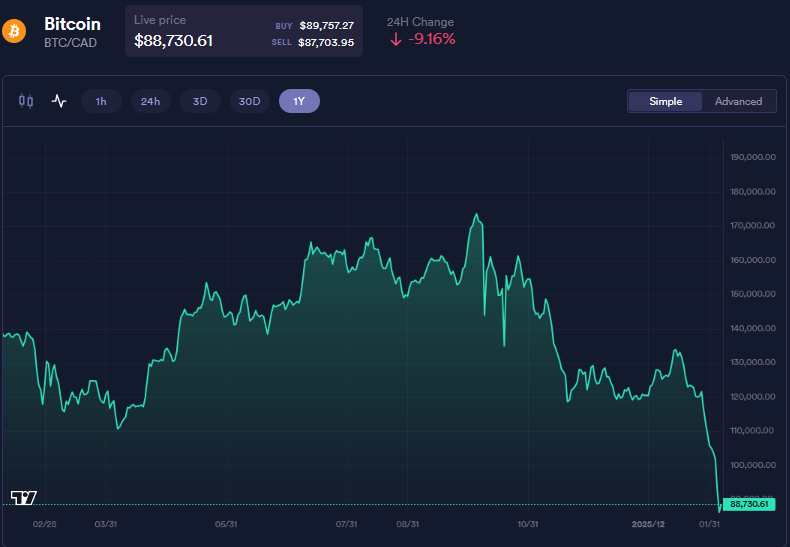
One year price chart of Bitcoin in Canadian dollars showing significant volatility, with prices declining sharply into early February 2025 and falling below the $100,000 CAD level.
Among those weighing in is Mike Novogratz, the Founder & CEO of Galaxy Digital, who has spoken publicly about the current phase of the market through the lens of prior cycles.
Back in March of 2025, Novogratz was interviewed by Anthony Pompliano, and at that time, he emphasized that crypto markets are shaped as much by narrative as by structure. Suggesting that Bitcoin’s value cannot be separated from the story built around it over time.
He has argued that if Bitcoin were forked and renamed, it would not carry the same credibility or meaning. In his view, gold of the digital age is the coin’s narrative. When he made these observations, Bitcoin had pulled back following Trump’s crypto ball and the launch of his namesake meme coin, at the time BTC was trading near $106,000 CAD.
Novogratz has also spoken about how difficult belief can be to sustain. Building community, maintaining momentum, and keeping participants engaged requires more than technical design. The Bitcoin whitepaper, which he has likened to a constitution, defines the rules, but markets still rely on people choosing to participate within those rules over time.
Novogratz acknowledged that recent BTC price behaviour has challenged expectations. “Bitcoin was not supposed to act like this. Something went wrong,” he said in a Bloomberg interview, underscoring the uncertainty that accompanies moments of strain. He also brought up psychological thresholds, describing the one hundred thousand dollar level as significant in both directions. On the way up, it reinforced confidence and narrative strength. On the way back down, it became a point of reassessment for many participants.
Historical Bitcoin market corrections
The table below highlights several major Bitcoin drawdowns over the past decade. It shows why Novogratz says “pain is part of the ethos of this industry”, those who have held with “diamond hands” during these cycles know how that feels. These episodes are often referenced when discussing volatility, though past conditions should not be understood as predictive of future outcomes.
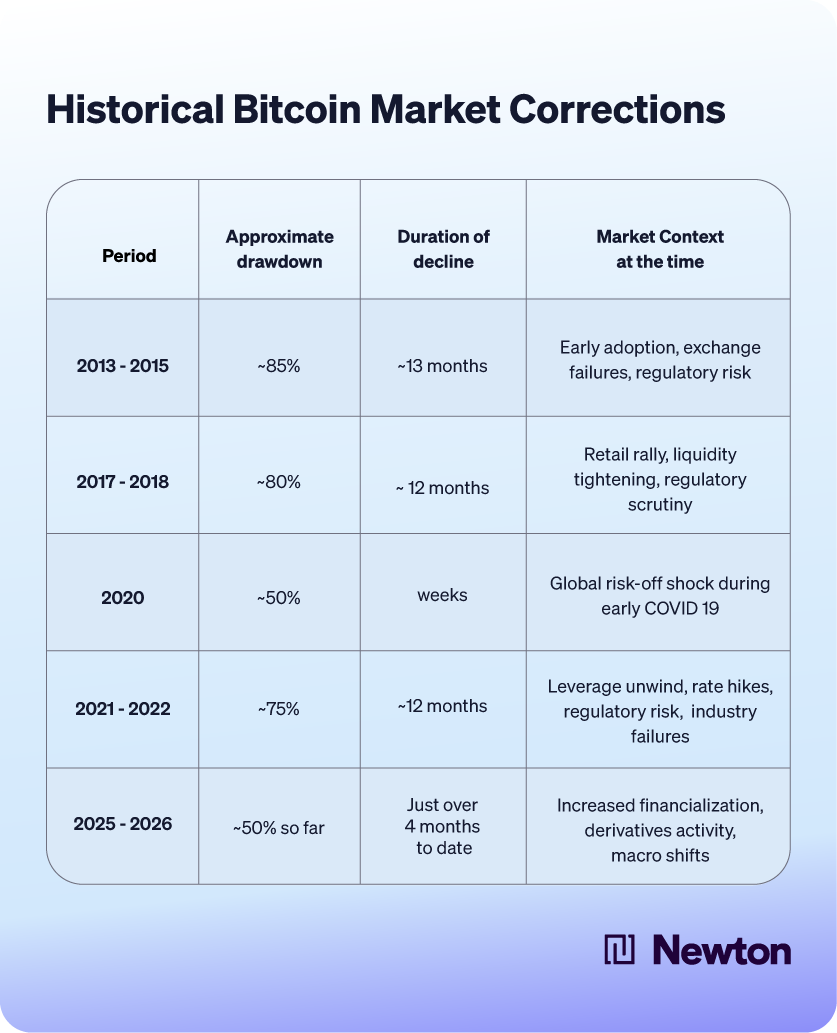
Across these periods, downturns looked very different. Some took months to play out, while others happened fast after major events like the FTX collapse or the start of COVID-19. These moments are often used to add context, but each one happened under its own set of conditions.
Another perspective comes from Cathie Wood, who has spoken publicly in recent weeks about how she interprets the October 10 market event and its aftermath.
Wood has described that episode as a significant liquidation moment linked, in her view, to how auto deleveraging affected cryptocurrency markets in the fourth quarter last year. In interviews and public commentary, she has suggested that the automated deleveraging mechanisms at Binance were behind the October 10th liquidation. These remarks reflect her interpretation of market mechanics on that day rather than a definitive broadly settled account of the cause.
She has also emphasized that the impact of large liquidation events is not always confined to a single day. According to Wood, forced deleveraging can result in extended adjustment, as positions unwind and liquidity conditions gradually rebalance. In that context, she has suggested that some recent volatility may still reflect residual effects from the earlier structural stress.
Wood’s comments add another lens through which recent volatility could be interpreted, highlighting how interconnected systems can transmit stress over longer horizons than participants might initially expect.
Jack Mallers addressed the broader questions of trust and accountability following renewed public attention around the Epstein files release. His remarks focused less on short-term market dynamics and more on Bitcoin’s philosophical positioning during moments of institutional scrutiny. Saying “the last thing I will do is let Jeffery Epstein rob us humans of the invention that is Bitcoin.”
Mallers described Bitcoin as “a neutral, open-source public utility,” comparing it to water, fire, or the internet. In his framing, Bitcoin is not a person or an institution, and it does not rely on secrecy or discretion. Its rules are public, its operation is transparent, and participation does not depend on trust in any single authority. Bitcoin operates as a decentralized autonomous organization, a DAO.
Mallers argued that systemic failures should not be conflated with the tools people use to navigate them. “Corrupt people do not get to rob humanity of our chance to fix the mess we inherited,” he said, adding that in his view, Bitcoin represents a response to structural breakdown rather than its cause.
He finished the post by emphasizing “we are fighting for human prosperity and the future of our kids” and that we did not have a say in the world we inherited, but we can have a say in the world we build. Reminding his listeners that if there was a backdoor, we could see it because we can audit the open-source code.
As the perspectives above illustrate, periods of adjustment often revive long-standing debates around narrative, leverage, and participation. Volatility of this magnitude helps explain why terms like “diamond hands” became part of the crypto lexicon.
Novogratz once quoted the 1997 song “Tubthumper,” made popular by Chumbawamba, as a way to describe the Bitcoin community. For those unfamiliar, the chorus goes:
“We’ll be singing when we’re winning,
we’ll be singing.
I get knocked down, but I get up again—
you’re never gonna keep me down.
The question is, 10 years into blockchain’s discovery, does the community have the stamina to get back up again?
If you enjoyed this article, visit our blog for updates in the dynamic blockchain space and for more information on Bitcoin click here.



.png)